Published · Updated
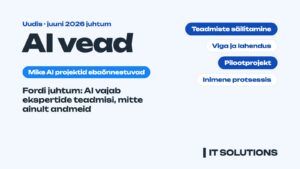
In short: On 20 November 2026, Äritehnoloogia reported that Estonian software company GrowthOn is building an AI-based production planning system for factories that rebuilds the plan when an order changes or a process stops. AI production planning only works when orders, routings, working hours and machine status exist in digital form – usually in an ERP, not in Excel. Estonian manufacturers should start by cleaning up their data and running a small pilot; among EIS grants, the Enterprise Development Programme, for example, was open as of 26.11.2026.
A production plan that looks perfect in the morning and is out of date by lunch is familiar to almost every factory in Estonia. A customer changes the quantity, material arrives late, a machine stops – and someone has to rework the Excel sheet by hand. In November 2026, Estonian business media reported that a local company is developing a system that does this rescheduling automatically with AI. This article explains what AI production planning actually means, what data it needs, why Excel is not enough and what a realistic path looks like for a small or mid-sized Estonian manufacturer.
What is the news?
On 20 November 2026, Äritehnoloogia.ee published the article “Eesti IT-firma loob tehastele AI abil süsteemi, mis tellimuse muutudes uuendab ka plaani” (“Estonian IT company builds an AI system for factories that updates the plan when an order changes”, by Indrek Kald). According to its lead, an Estonian software company is building an AI-based production planning system for factories that draws up a new plan when an order changes or a process stops.
The article’s tags name the company as GrowthOn OÜ, and its co-founder and CEO Martin Rebane is quoted as saying that production planning is a major bottleneck for factories. The article is behind a paywall, so we do not repeat details we could not verify ourselves, such as customers, prices or timelines. For us the news matters mainly because it highlights a problem we also see in ERP projects: the plan exists, but it cannot keep up with change.
What does AI actually do in production planning?
AI does not replace the planner; it quickly calculates the possible plan variants and suggests the best one when something changes. A traditional plan is static; an AI-based plan is recalculated after every event.
In practice, several different tasks tend to be grouped under the “AI” label:
- Event-driven rescheduling. When an order’s quantity or due date changes, a machine stops or material is delayed, the system recalculates the job sequence and machine load.
- Optimisation. The system looks for a sequence that reduces changeovers, idle time and late orders while respecting constraints such as machine capacity, shifts and material availability.
- Forecasting. Historical data is used to estimate how long jobs really take, what demand is likely to be or when equipment needs maintenance.
- Explanation and communication. A language model can explain to the planner in plain words why the plan changed and which orders are affected, or draft a message to the customer about a new delivery date.
It is important to tell these apart: optimisation and forecasting are mathematics and machine learning, not a chatbot. A tool like ChatGPT will not produce a production schedule on its own – it needs a system with real data and rules behind it.
What data does AI planning need?
AI planning needs structured, up-to-date data on orders, products, routings, resources and actual production. If that data does not exist or is spread across separate files, the AI has nothing to build a plan from.
| Data | What it contains | Where it usually lives |
|---|---|---|
| Orders | Product, quantity, due date, priority, change history | ERP, online store, CRM or email |
| Bill of materials (BOM) | Components and materials of each product | ERP, or drawings and Excel |
| Routings | Operation sequence, machines, standard times | The foreman’s head, Excel, MES |
| Resources | Machines, shifts, staff skills, holidays | Time tracking, HR, Excel |
| Stock and purchasing | Material availability and lead times | ERP, warehouse software (WMS) |
| Actual production | Job start and finish, scrap, downtime | MES, machine sensors, manual entries |
The last row is the one most often missing: data on how long a job actually took. Without it, every plan relies on standard times that may not match reality. That is why the first step of an AI project is often simple: let workers record the start and end of each job on a tablet or shop-floor terminal.
Why is Excel not enough, and where do ERP and MES fit?
Excel works for planning as long as changes are rare and one person knows the plan. AI planning needs a single source of data that receives changes automatically – that is the role of ERP (the business side) and MES (the shop-floor side).
ERP holds orders, products, stock, purchasing and invoices. MES (manufacturing execution system) tracks what happens on the shop floor: work orders, operations, machine status. For a smaller manufacturer, both can be one system. For the basics, see our guide What is ERP?
| Criterion | Excel | ERP/MES + AI planning |
|---|---|---|
| Order change | Someone has to enter it manually | Arrives automatically, the plan is recalculated |
| Several users | Version chaos, “final_v7.xlsx” | One valid plan for everyone |
| Machine downtime | The planner hears about it by phone or word of mouth | Downtime is logged and affected jobs are moved |
| History and analysis | Hard to compile | Actual times are stored and improve the next plan |
| Know-how | In one planner’s head | Rules are written into the system |
| Start-up cost | Low | Higher, but depends on scope |
If your plan lives in Excel today, you do not need to buy a large manufacturing system right away. A sensible first step is often to replace Excel with custom business software that collects orders and working hours in one place. The AI layer comes once the data can be trusted.
How much does AI-based production planning cost?
The price depends mostly on the state of your data and the number of systems to integrate – the AI model itself is often the smaller part of the cost. A realistic start is a limited pilot on one production line or product group.
Costs usually break down like this:
- Data clean-up – BOMs, routings and standard times in digital form.
- Integrations – ERP, online store, accounting, time tracking and, if needed, machines.
- Planning logic and AI – rules, optimisation, forecasting model.
- User interface – planner view, shop-floor terminal, notifications.
- Maintenance and cloud services – monthly costs after launch.
Off-the-shelf software is usually billed monthly per user or per plant; custom development by the hour. Our hourly rate for ERP and software development is €60 + VAT, so a 100-hour pilot would cost €6,000 + VAT. That is an example calculation, not a quote – the real scope becomes clear after reviewing your data. The most expensive mistake is to start building AI before checking whether the data exists at all.
Can you get EIS funding for AI planning?
Yes, some digitalisation grants also cover developing production planning and data exchange, but rounds open and close. Before a project, check the status of the specific grant on eis.ee.
According to the EIS digitalisation page, the situation on 26.11.2026 was:
| Grant | Maximum | Self-financing | Status on 26.11.2026 |
|---|---|---|---|
| Enterprise Development Programme | up to €500,000 per development project | at least 55% | open |
| RTE Grant for Software Implementation and Integration | €5,000 | 50% | open |
| RTE Grant for Business Process Automation and Data Exchange | €150,000 | 50% | closed (applications ended 04.09.2026) |
| Support for digitalisation roadmap advisory and development activities | €35,000 | 30–50% | closed |
The terms of the business process automation grant list production plans, warehouse management and accounting as examples, provided the solution is part of a wider process. Applicants needed a valid digitalisation strategy or an equivalent document. Read more in our articles on the business process automation grant and the EIS digitalisation grant. For industrial companies, the AI and robotics centre AIRE also offers AI pre-consultation, demo projects and funding advice.
What does this mean for Estonian companies?
Estonian manufacturers are mostly small and flexible: many custom orders, small batches and frequent rescheduling. That is exactly where automatic rescheduling helps most – and exactly where data most often lives in Excel and in people’s heads.
- Orders arrive through many channels. Some by email, some via a B2B online store, some by phone. They need to be collected in one place before planning; AI can also help extract data from emails and PDF orders automatically.
- Accounting runs in Merit, Directo or another Estonian program. The planning system must exchange data with it so that purchasing and invoicing do not become a separate island.
- Multilingual teams. Shop-floor terminals and notifications often need to work in Estonian and Russian.
- Data protection. If the system uses employee data (shifts, working time), GDPR applies; with cloud-based AI, it is worth knowing where the data is processed.
What should you do now?
- Write down how many times a week the plan changes and how much time rescheduling takes. That is your business case.
- Map where orders, BOMs, routings and working hours are stored – in which system or file.
- Start recording actual job times, even with a simple terminal or form.
- Choose one line or product group with the most changes for a pilot.
- Decide whether off-the-shelf planning software fits or whether you need a custom solution integrated with your ERP.
- Check on eis.ee which grant is open and plan your self-financing.
How can IT Solutions Group help?
IT Solutions Group builds custom ERP and production solutions for Estonian companies: order, stock and work-order management, shop-floor terminals, and integrations with accounting and online stores. We start with a data review and a small pilot and add AI-based planning once the foundation is in place. See our custom ERP system development service and AI solutions for business. Our rate for ERP and custom development is €60 per hour + VAT.
Frequently asked questions
What is AI production planning?
AI production planning means software automatically recalculates the production schedule when an order, material or machine status changes. It uses optimisation and forecasting to find the best job sequence. The planner then approves or adjusts the suggested plan.
Do I need an ERP for AI planning?
It does not work without a single source of data. If orders, BOMs and stock levels are in an ERP, AI can use them reliably. A small manufacturer may start with a simple business system that replaces Excel and gathers data in one place.
Can an Excel-based plan be automated with AI?
Partly, but it is fragile. Changes do not reach Excel automatically, and several users create version chaos. It is better to move the Excel data into a system that records changes and keeps history.
How long does an AI planning pilot take?
It depends mostly on the state of the data and the number of integrations. If data is already in an ERP, a pilot on one line can start faster; if routings and standard times still need to be written down, most of the time goes there. Estimate the timeline after a data review.
Which EIS grant suits manufacturing digitalisation?
As of 26.11.2026, the EIS page lists the Enterprise Development Programme (up to €500,000 per development project) and the RTE software implementation grant (€5,000) as open. The business process automation grant of up to €150,000 has been closed since 04.09.2026. Always check round status on eis.ee before applying.
Sources
- Äritehnoloogia – Eesti IT-firma loob tehastele AI abil süsteemi, mis tellimuse muutudes uuendab ka plaani (checked 26.11.2026)
- EIS – Digitalisation: grants and services (checked 26.11.2026)
- EIS – RTE Grant for Business Process Automation and Data Exchange (checked 26.11.2026)
- AIRE – AI & Robotics Estonia (checked 26.11.2026)