Published · Updated
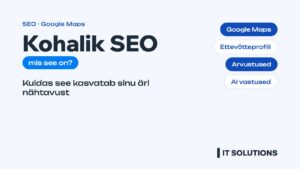
In short: Local SEO means optimising your website and Google Business Profile so your company appears in Google’s map pack, Google Maps and AI answers when someone searches for your service in their town or “near me”. Google ranks local results on three factors: relevance, distance and prominence. Local SEO grows your business’s visibility because the map pack sits above the regular results and drives calls, directions and website visits. The core work is a free Business Profile, consistent business details, reviews and local service pages.
When someone searches for “car repair Tartu”, “dentist Mustamäe” or “web design Tallinn”, Google first shows a map with three businesses and only then the regular results. Whoever is in that top three gets most of the calls. This article explains what local SEO is, how Google ranks local businesses and how local SEO grows your business’s visibility step by step.
What is local SEO?
Local SEO (in Estonian kohalik SEO) is the part of search engine optimisation that deals with location-based searches. The goal is to make your business visible where local customers look:
- Google’s map pack (local pack) – a map and three businesses above the search results;
- Google Maps – searches in the maps app, often on a phone and on the move;
- regular results for queries that include a town or district;
- AI answers – Google AI Overviews, ChatGPT and other AI search tools use business profiles, reviews and websites to make recommendations.
Regular SEO helps you compete across Estonia or worldwide. Local SEO helps you win customers who are nearby and ready to buy now.
Who is local SEO for?
Local SEO matters for any business whose customers are in a specific area:
- businesses with a physical location: restaurants, cafés, beauty salons, clinics, car repair shops, stores, gyms;
- service-area businesses: builders, plumbers, cleaners, movers, couriers;
- professional services: accountants, lawyers, estate agents, web studios;
- multi-location businesses, for example with offices in Tallinn, Tartu and Pärnu.
How does Google rank local results?
According to Google’s own guide, local ranking depends on three factors:
| Factor | What Google assesses | What you can do |
|---|---|---|
| Relevance | How well your Business Profile matches the search | The right primary category, a list of services, a full description, service pages on your website |
| Distance | How far your business is from the searcher or the location in the query | An accurate address or service area; distance itself cannot be changed |
| Prominence | How well known and trusted your business is online and offline | Reviews and replies, mentions in media and directories, links, a solid website |
Google also confirms that review count and rating factor into local ranking, and that replying to reviews shows you value customers. You cannot pay for a better position in local results: ads are separate and labelled.
How does local SEO grow your business’s visibility?
- Visibility ahead of competitors: the map pack sits at the top of the page, often before regular results. On a phone it fills much of the screen.
- Straight to action: from your profile a customer can call, get directions or book with one tap, without opening your website.
- Trust: stars and reviews help people choose before first contact.
- Ready-to-buy customers: someone searching “near me” or with a town name usually wants to buy soon.
- AI recommendations: AI search uses the same data for local recommendations. A tidy profile and reviews also help you get into ChatGPT and Google AI answers; see GEO optimization.
- Three languages: people in Estonia search in Estonian, Russian and English. A multilingual profile and website reach all three audiences.
Local SEO step by step
1. Create and verify your Google Business Profile
Google Business Profile is free and the foundation of local SEO. Verify ownership: an unverified profile shows less information and can be edited by others.
2. Choose the right primary category and add services
The primary category has the biggest effect on relevance. Pick the most precise one (for example “Dentist”, not “Health”), add secondary categories, a list of services with prices, opening hours, holiday hours, photos and a description.
3. Keep your business details identical everywhere
Your name, address and phone number (NAP) must match on your website, Google profile, the Business Register, Facebook, Estonian directories such as 1182.ee and Inforegister, Apple Business Connect and Bing Places. Inconsistencies confuse both Google and AI.
4. Collect reviews and reply to every one
Ask for a review after every successful job by sending a link by email or SMS. Reply to all reviews, including negative ones, calmly and specifically. Do not buy fake reviews: the EU Omnibus Directive bans them, and Google removes them and may suspend the profile.
5. Create local service pages on your website
Every main service needs its own page that clearly says where you offer it: town, districts, service area, address and map. If you genuinely serve several towns, give each a substantive page with its own examples, prices and contacts. Do not create dozens of near-identical “service + town” pages: Google treats them as spam (doorway pages).
6. Add LocalBusiness structured data
Schema.org LocalBusiness markup tells Google your name, address, phone, opening hours and location in machine-readable form. It does not raise rankings directly, but helps Google and AI understand your data correctly. More: schema markup for AI visibility.
7. Keep your profile active
Regularly add photos of your work, team and premises, post offers and news, answer questions and update hours over holidays.
8. Earn local mentions and links
Local media, city portals, industry associations, partners, sponsorships and events bring mentions that raise prominence for both Google and AI.
What are the most common local SEO mistakes?
- Keywords in the business name (e.g. “Firma OÜ – best cheap car repair Tallinn”) – this breaks Google’s guidelines and can get the profile suspended.
- A virtual office address – if you do not serve customers there, use a service area.
- Several profiles for one business – duplicates split reviews and confuse Google.
- Outdated details – a wrong phone number or opening hours lose customers immediately.
- Only one language – if a customer searches in Russian but your site and profile are only in Estonian, they go to a competitor.
- Unanswered reviews – especially negative ones, which every future customer reads.
How do you measure local SEO results?
- Business Profile performance: calls, direction requests, website clicks and the searches people used to find you.
- Search Console: impressions and clicks for queries with town and district names.
- Google Analytics 4: add a UTM tag to your profile’s website link (e.g.
?utm_source=google&utm_medium=organic&utm_campaign=gbp) to see visits and enquiries from the profile separately. - Enquiries: ask new customers whether they found you on Google Maps.
How quickly does local SEO deliver results?
Profile fixes (category, services, details) often take effect within a few weeks. The impact of reviews, local pages and mentions builds over 2–6 months and depends on competition: central Tallinn is slower than a smaller town. Local SEO is ongoing work, because competitors do not stand still.
If you would like us to do this for you, see our local SEO and Google Business Profile service. For wider SEO, see SEO services, or start with a free website audit.
Frequently asked questions
What is local SEO in short?
Optimising your website and Google Business Profile so that your business appears in Google’s map pack, Google Maps and AI answers when someone searches for your service in their area.
How is local SEO different from regular SEO?
Regular SEO focuses on your website’s rankings across a country or the world. Local SEO adds your Google Business Profile, reviews, consistent business details and location pages, because local results are ranked on relevance, distance and prominence.
Is local SEO free?
Google Business Profile is free and you can do the core work yourself. What costs is time or help: setting up the profile, writing local pages, running a review process and ongoing upkeep.
Does local SEO work for a business without an office?
Yes. A service-area business, such as a builder or cleaning company, can hide its address and set the areas where it serves customers.
Do reviews affect Google Maps rankings?
Yes. Google confirms that review count and rating factor into local ranking. Replying to reviews matters too.
Sources
- Google Business Profile Help – Tips to improve your local ranking on Google
- Google Business Profile Help – Guidelines for representing your business on Google
- Google Search Central – LocalBusiness structured data
- Google Search Central – Spam policies (doorway abuse)
- Apple Business Connect
- EUR-Lex – Directive (EU) 2019/2161 (Omnibus Directive, fake reviews)