In short: Choose WooCommerce if you need Estonian payment and shipping methods, an accounting integration, several languages or B2B prices, and want the store and its data to stay yours. Choose Shopify for a quick start with standard selling if you are happy to pay monthly platform and app fees.
If you are planning an online store in Estonia, you will almost certainly ask: WooCommerce or Shopify? Both are among the most popular e-commerce platforms in the world and both can sell well. The difference is who owns the store, how the costs add up and how easily you can connect Estonian payment, shipping and accounting solutions. This guide compares them honestly – we have built WooCommerce stores for small shops as well as a catalogue of more than 8,000 products.
What are WooCommerce and Shopify?
WooCommerce is a free, open-source e-commerce plugin for WordPress. The store runs on hosting you choose, the code and data are yours, and it can be extended with thousands of plugins or custom development.
Shopify is a paid cloud service (SaaS). The platform takes care of servers, security and updates; you pay a monthly plan and add features from its app store.
Costs: monthly fees vs development and maintenance
- WooCommerce: no platform fee and no percentage of sales. Costs are hosting, domain, any paid plugins, development and maintenance. The initial investment is usually higher, the monthly cost lower.
- Shopify: a monthly plan starting from a few tens of euros, plus paid apps on top. If you use an external payment provider, Shopify charges an extra fee on every sale. The start is cheaper, but costs grow with revenue and the number of apps.
Compare the total cost over three years, not only the launch price.
Estonian payments, parcel lockers and accounting
Estonian shoppers expect bank links, card payments and parcel lockers. In WooCommerce these come as ready-made plugins: Montonio for bank links, cards and pay later, and Omniva, Smartpost and DPD parcel lockers. We describe the setup in Montonio, Omniva and Smartpost in WooCommerce.
The gap is even bigger for accounting. WooCommerce can connect directly to Merit Aktiva or Directo so that invoices, customers and stock flow automatically – see WooCommerce integration with Merit Aktiva and Directo. On Shopify you depend on whether a suitable app exists and what it allows.
Control, data and flexibility
- Ownership: a WooCommerce store lives on your server and can move to another partner at any time. A Shopify store lives in the platform account, under its rules.
- Customisation: in WooCommerce almost everything can be changed – checkout, pricing, product logic. On Shopify the platform sets the limits.
- Multiple languages: possible on both; on WooCommerce usually with WPML, which works well for Estonian, Russian and English.
- B2B: customer-specific prices, pay by invoice and wholesale orders are flexible in WooCommerce, see B2B e-commerce.
When to choose WooCommerce
- you need Estonian payment and shipping methods and an accounting integration;
- the store is multilingual or also sells to businesses;
- you want custom features or a connection to your ERP, CRM or warehouse system;
- you want the store and data to stay yours, with no fees that grow with revenue;
- you want strong SEO and content marketing on the same platform – WordPress is excellent for a blog and content pages.
When to choose Shopify
- you want to launch very quickly with a simple product range;
- you mostly sell internationally with standard processes;
- you do not need a tight accounting or warehouse integration;
- you prefer to pay a monthly fee rather than deal with hosting and updates.
Can you migrate from Shopify to WooCommerce?
Yes. Products, categories, customers and orders can be transferred, and old URLs are 301-redirected to the new ones to keep your Google rankings. Plan the URL structure and store SEO before migrating, see e-commerce SEO.
Our recommendation
For most small and medium-sized Estonian online stores we recommend WooCommerce: it connects to local payment, shipping and accounting solutions, the store stays yours and it can grow with the business. If your process is so specific that no platform covers it, we build custom software. See how we approach WooCommerce development.
Frequently asked questions
Which is cheaper, WooCommerce or Shopify?
Shopify is cheaper to start, but the monthly plan, app fees and – with an external payment provider – transaction fees grow with the business. WooCommerce costs more to build initially but has no platform fee or percentage of sales. Compare the three-year total cost.
Is WooCommerce secure?
Yes, when it is maintained: WordPress, WooCommerce and plugin updates, backups, secure hosting and monitoring. That is why an online store should have a maintenance agreement.
Can Shopify use Montonio and parcel lockers?
Yes, through apps. Features and prices depend on the app, so check in advance that every payment and shipping method you need is supported.
Is WooCommerce suitable for a large catalogue?
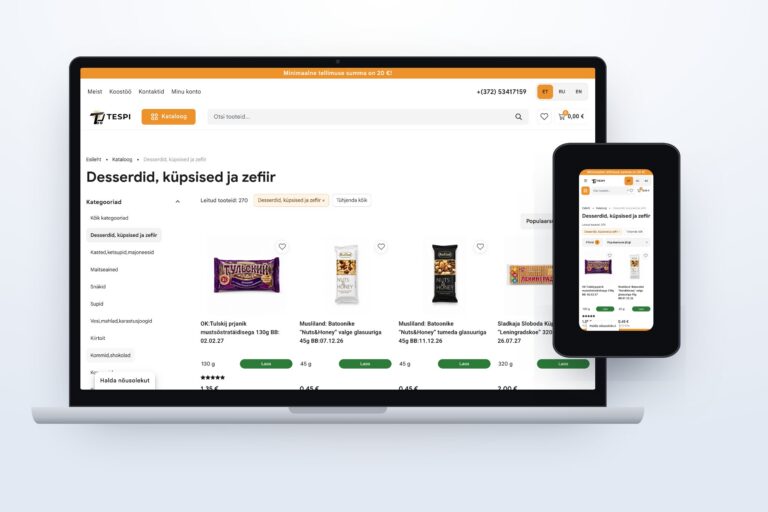
Yes. We have built a WooCommerce store with more than 8,300 products and 160 categories in three languages. Large catalogues need good hosting, caching, search and filters.
How long does it take to build a WooCommerce store?
Our latest stores launched in 6–7 weeks, including payments, parcel lockers and integrations.
Not sure which platform suits your store? Contact us – we will review your needs and give you an honest recommendation.